
The Digital Double Diamond
The Digital Double Diamond (DDD) isn’t about teaching designers how to design.
It’s a framework for Delivery Leaders, Project Managers and Programme Managers who are expected to track, report and forecast progress on creative work that doesn’t move in neat, linear phases.
In large digital programmes, different workstreams sit in different states at the same time. Without a shared framework, status becomes vague, trust erodes and it’s hard to spot where delivery flow is starting to break down.
This model gives you a clear way to see where work really is, communicate it simply to stakeholders and intervene early when things start to get stuck.
It’s the Design Council’s Double Diamond you know and love, adapted for the realities of digital design delivery.
Based on the classic four-phase model: Discover, Define, Design and Deliver, this version gives PMs the visibility they need to stay in control. You can see where work is, spot delays early and guide teams through to delivery without second guessing.
Unlike the traditional model, I split the Design phase into two clear parts:
-
Low-fidelity design is where we explore options and solve the problem. It ends with fully signed-off wireframes, so everyone is aligned before moving into visual design.
-
High-fidelity design is where we create the final design for approval. This becomes the reference point for remaining breakpoints and developer handoff.
That split makes a huge difference. It shows you exactly where work is in the process, which tasks are blocked, and how fast you’re really moving.
And once you can track flow properly, you can start to forecast with confidence. No more vague status updates. Just clear, evidence-based answers to the questions that matter, like how long something will take, or how many more sprints are needed.
This model gives you control in the chaos and a way to lead with clarity across multiple workstreams.
The framework for tracking and reporting creative digital delivery
This is the part no one ever explains properly. What actually happens in each phase? Where does design really begin and end? And why do some tickets move like lightning while others feel like they’re stuck in the Upside Down?
Here’s how the digital double diamond actually plays out, with the right structure, the right mindset, and the right project management superpowers at every step.
The diagram below shows the baseline structure I use to anchor delivery reporting for digital design workstreams. It’s not a step-by-step process, but a shared reference point for visibility and control.
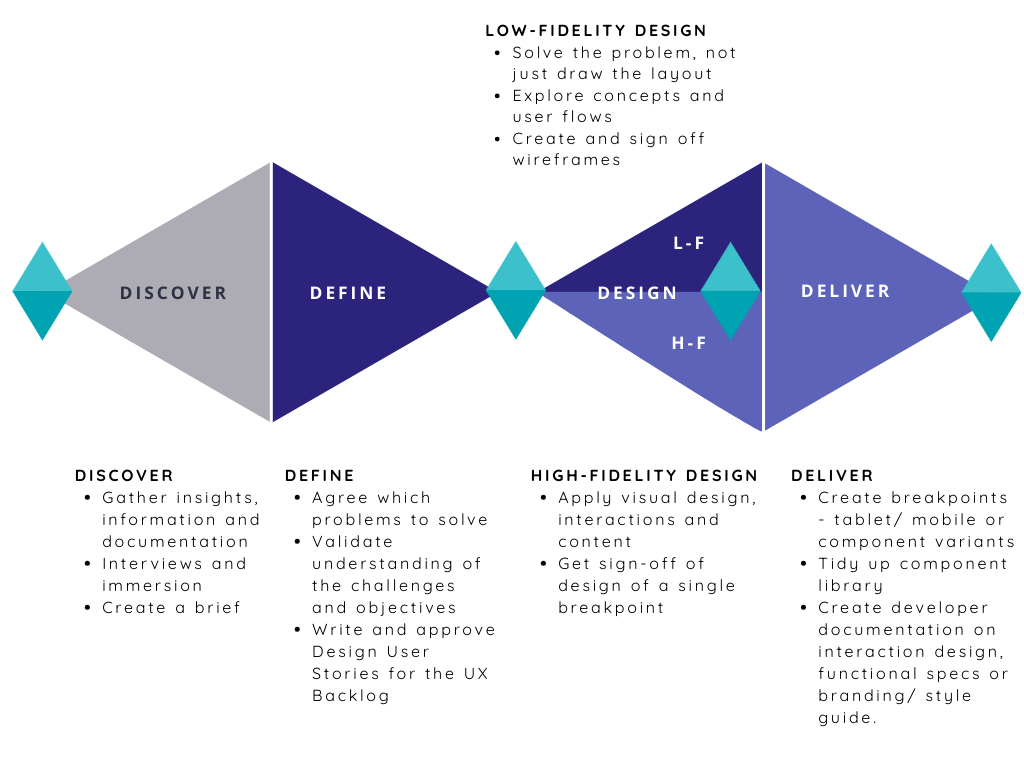
This framework gives you the structure to build meaningful reporting, and the clarity to design your Jira boards, backlogs and workflows around real delivery flow.
PM superpowers by phase
Discover – Asking great questions, gathering facts, aligning people
Define – Prioritising problems, shaping the brief, getting to ‘yes’
Low-Fidelity – Driving decisions, scheduling reviews, keeping flow
High-Fidelity – Managing approvals, clearing blockers, syncing with devs
Deliver – Checking details, closing the loop, keeping the bar high
The importance of backlogs
Not all work flows straight through in a single motion, and that’s by design.
When a component has been solutioned but the rest of the page isn't ready, it should pause in the backlog. You don’t want to track cycle time on something that’s just waiting.
This is where the turquoise diamonds come in. They mark the natural pause points where you stop the clock and hold work until everything needed for the next stage is in place.
It’s the only way to use your data to forecast accurately, otherwise you’re measuring delays that aren’t real.
Reporting
Because everything’s set up neatly in phases, you can monitor and report on progress at a very high level, or a very detailed level, by sprint or by workstream.
I love the DDD and recommend it to every Digital PM because it’s:
- adapted to agile workflows and all the backlogs that ‘should’ go along with them
- it helps minimise scope creep
- it enables everyone to work to the same, clear set of rules
- and it makes tracking and reporting a doddle
Clear thinking, clearer delivery
This design version of Digital Superhero's Digital Double Diamond gives you a shared reference point for making sense of creative work, no matter how complex it gets.
It cuts through chaos, helps you spot where things get stuck and gives you the structure to track real progress, not just motion.
Most importantly, it gives you the thinking you need to design your Jira setup around how design work actually flows.
1:1 support with a digital delivery expert (that’s me)
Struggling to fix your Jira setup, automate reporting or get control of a runaway programme? You don’t have to figure it out alone.
I offer private 1:1 coaching for ambitious delivery managers, PMs and agile leads who want smarter systems, less stress and real results, super fast.
Let’s sort the chaos and set you up for calm, confident delivery.